Our lab is dedicated to researching the ways we learn language across modalities and how language experience impacts cognitive development.


We are the Gallaudet University Multimodality, Acquisition and Cognition (MAC) Lab, directed by Dr. Deanna Gagne. Our lab studies language acquisition and use across individuals with varied modality experiences, including visual (sign, gesture, written), tactile, and spoken/auditory.
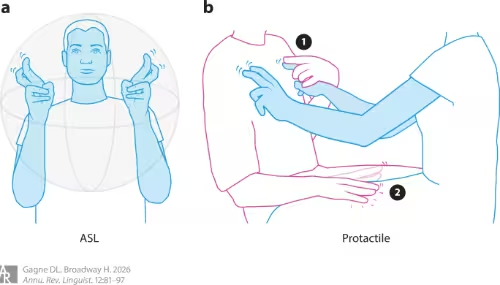
Gagne, D. L., & Broadway, H. (2026). From Contact to Conversation: Protactile Language, Modality, and Community. Annual Review of Linguistics, 12, 81–97. https://doi.org/10.1146/annurev-linguistics-011724-121536
Coppola, M., Flaherty, M., Gagne, D., Gagne, K., Kocab, A., Martin, A., Morales Blanco, D., Morales Ruíz, I., Pyers, J., & Senghas, A. (2025). Convergence and Emergence: How Nicaraguan Signing Has Been Shaped by Transmission, Acquisition, and Interaction. Sign Language Studies, 26(1), 69–103. DOI: 10.1353/sls.2025.a981200
We are a research laboratory focused on advancing the understanding and development of language.
The MAC Lab is a research-focused space that explores the intersection between technology and the needs of deaf and hard of hearing individuals. Through analysis and development, the lab investigates various technologies and tools for their potential in improving accessibility and communication. Our team's dedication to research aims to contribute to a broader understanding and facilitate discussions on technology's role within the deaf and hard of hearing communities.
Our team at the MAC Lab conducts interdisciplinary research that bridges the gap between technology and communication for deaf and hard of hearing individuals. We partner with experts in various fields, including linguistics, computer science, and engineering, to develop cutting-edge projects that aim to revolutionize the way our community experiences the world.
The MAC Lab is dedicated to providing deaf, DeafBlind, and hard of hearing individuals with research-based resources and opportunities to enhance our general knowledge of language and development by participating in current research. This then contributes to our dissemination of research-based educational content for the benefit of the community.